
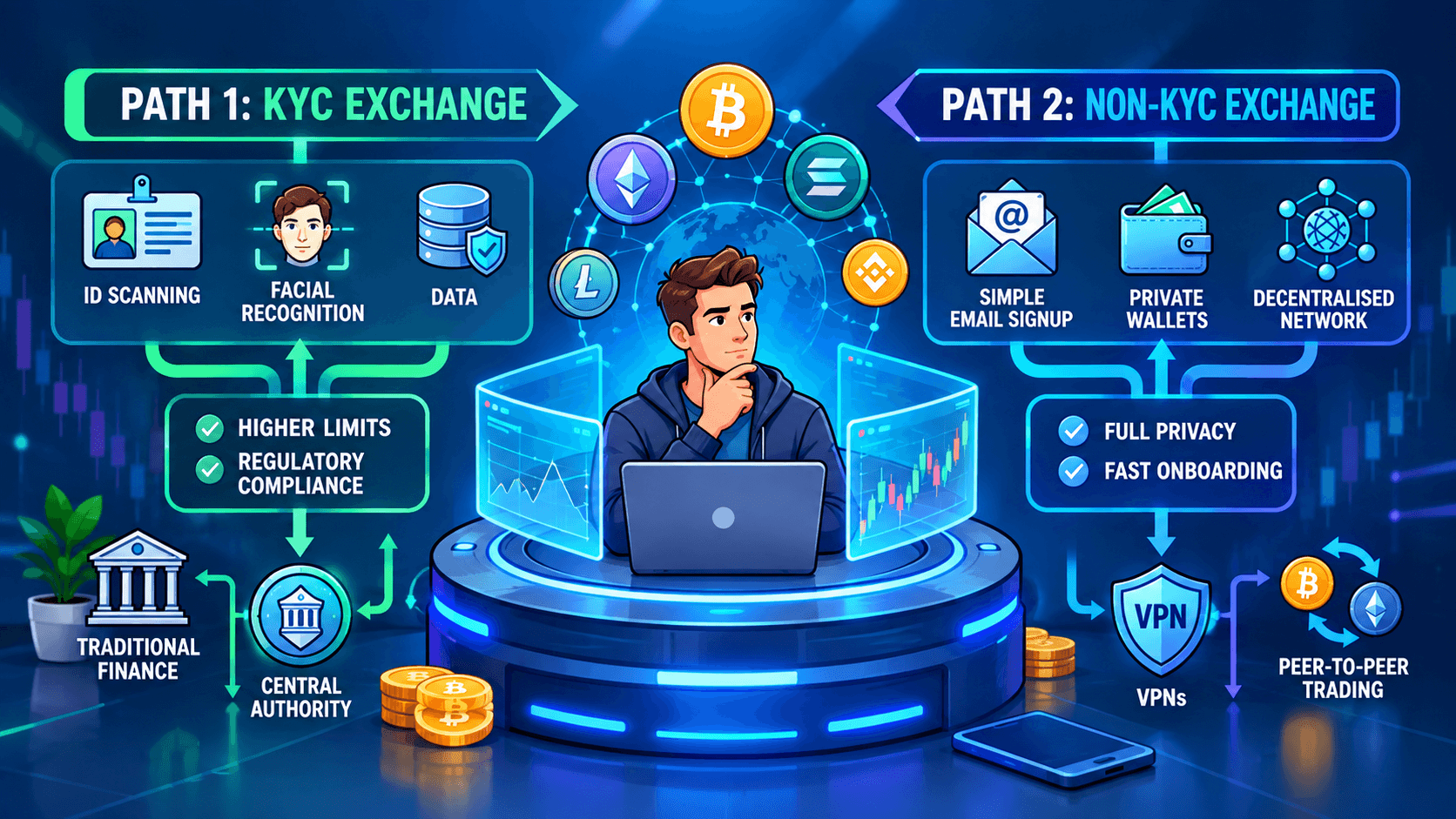

When I first got into crypto over a decade ago, trading felt raw and open. You created a wallet, managed your seed phrase, and swapped tokens directly. But over the last few years, the landscape shifted dramatically. Strict regulatory frameworks and Know Your Customer (KYC) mandates have turned crypto exchanges into institutions that mirror traditional banks, requiring passports, facial scans, utility bills, and Social Security numbers.
While compliance protects platforms from illicit activities, it creates a major drawback for everyday users: data exposure. Centralized databases holding millions of personal identities are prime targets for cyberattacks and data leaks.
If you want to protect your personal information, avoid corporate tracking, or simply trade without waiting days for manual identity verification, finding a reliable crypto exchange without verification is vital.
Below is my hands-on guide to navigating the top no-KYC crypto exchange options in 2026, based on practical experience, liquidity testing, security assessments, and privacy metrics.
What is a No-KYC Crypto Exchange?
A no-KYC crypto exchange is a trading venue, either centralized or decentralized, that allows you to deposit, trade, and withdraw digital assets without submitting government-issued identification documents.
Unlike traditional exchanges (like Coinbase or Kraken) that force identity verification before you can trade a single dollar, an anonymous crypto exchange operates under a privacy-first model:
- Non-Custodial / Instant Swap Services: Require zero account creation. You provide a receiving address, send your funds, and receive the swapped asset directly in your wallet.
- Decentralized Exchanges (DEXs): Run on smart contracts. You connect a Web3 wallet (like MetaMask, Phantom, or Rabby) and execute peer-to-peer trades without middleman intervention.
- Tiered / Non-KYC CEXs: Allow basic trading and limited daily withdrawals without ID verification, requiring KYC only if you exceed high withdrawal thresholds or attempt fiat bank transfers.
Why Use a Crypto Exchange Without Verification?
Trading on an anonymous crypto exchange isn’t about avoiding the law; it’s about maintaining sovereignty over your financial digital footprint. Here are the main drivers:
- Enhanced Data Privacy: Every time you upload your ID to an exchange, you risk having your home address, passport details, and photo leaked in a corporate data breach.
- Instant Trading Access: Traditional identity verification can take hours, sometimes days if manual document reviews fail. No-KYC platforms let you swap assets within seconds.
- Financial Inclusion: Millions of unbanked individuals globally lack standardized identity documents or recognized proof of address, cutting them off from traditional finance.
- Protection Against Surveillance: Financial surveillance and chain-analysis indexing build full behavioral profiles based on tied real-world identities.
The Top No-Verification Crypto Exchange 2026 Options Reviewed

I evaluated dozens of non-KYC venues based on trading fees, user interface, chain support, liquidity depth, and security history. Here are my top choices for 2026.
1. Best Wallet – Best Overall for Mobile Self-Custody & Swaps
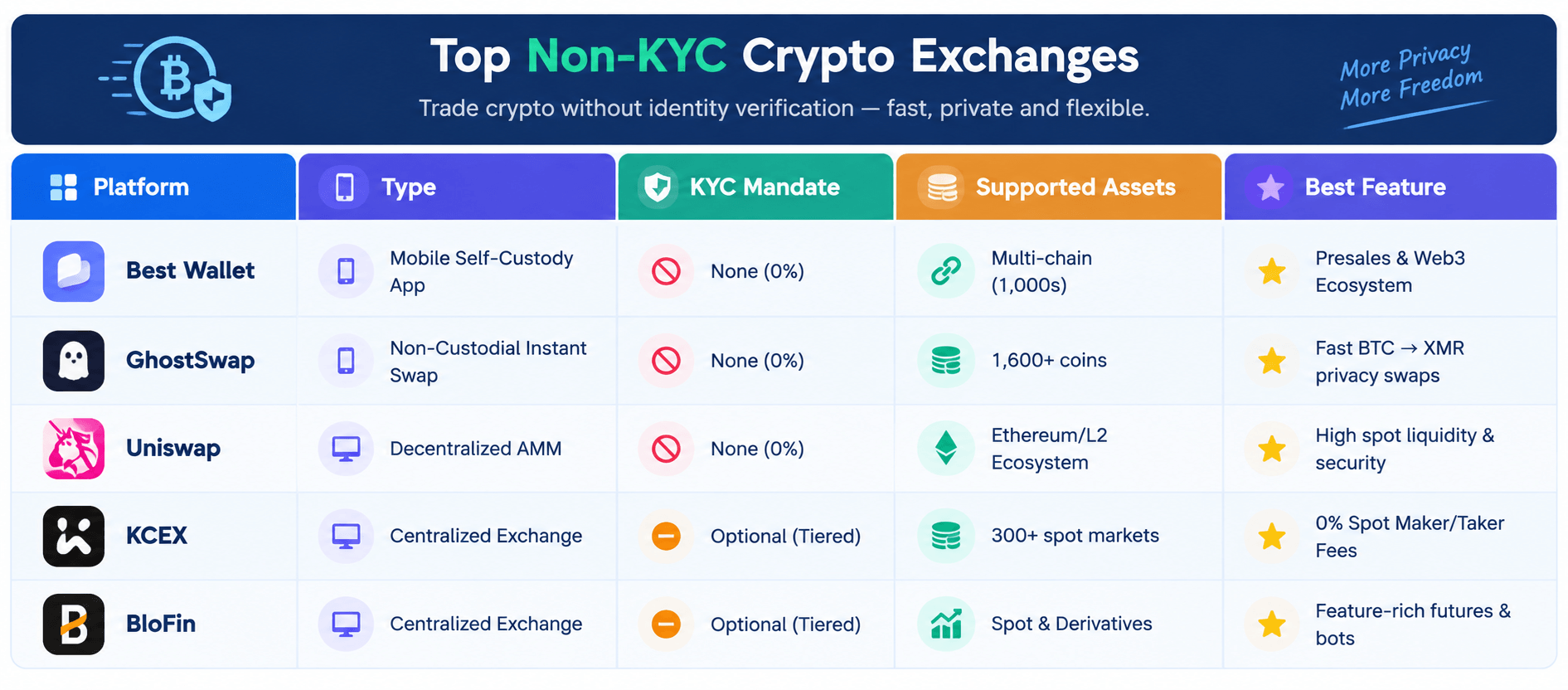
Best Wallet has quickly emerged as a standout mobile-first ecosystem. It combines a non-custodial Web3 wallet with an integrated DEX aggregator, allowing you to swap thousands of tokens across multiple chains without completing identity verification.
- Type: Non-Custodial Mobile App / DEX Aggregator
- KYC Requirement: None (0%)
- Key Features: Cross-chain swaps, presale aggregator, multi-chain asset management.
- Best For: Mobile traders who want full wallet custody combined with fast, multi-chain swaps.
2. GhostSwap – Best No KYC Exchange for Instant & Cross-Chain Swaps
For traders who prefer browser-based swaps without opening an account or downloading an app, GhostSwap is one of the smoothest non-custodial tools. It functions by searching across liquidity providers in real time to deliver fast swaps directly to your personal wallet.
- Type: Non-Custodial Instant Exchange Router
- Supported Assets: 1,600+ cryptocurrencies
- Key Pair: Highly popular for BTC-to-XMR (Monero) anonymous swaps.
- Best For: Quick, high-privacy token exchanges directly between self-custodial wallets.
3. Uniswap & Curve Finance – Best Decentralized Exchanges (DEXs)
When discussing pure decentralization, on-chain automated market makers (AMMs) remain essential. Uniswap dominates Ethereum, Arbitrum, Optimism, and Polygon spot trading, while Curve handles stablecoin swaps with minimal slippage.
- Type: On-Chain AMMs / Smart Contracts
- KYC Requirement: Completely impossible by protocol design
- Key Advantage: Deep liquidity, total self-custody, and complete transparency on-chain
- Drawback: Requires native gas tokens (ETH, MATIC, ARB) and basic Web3 wallet knowledge.
4. KCEX & BloFin – Best Non-KYC CEX Options for Spot & Derivatives
If you need advanced order-book features such as limit orders, spot charts, or futures leverage, certain centralized platforms still offer basic tiers without forced verification.
- KCEX: Known for offering zero maker and taker fees on spot trading alongside zero-KYC withdrawal limits.
- BloFin: Excellent option for futures and perpetuals trading without upfront ID verification, featuring advanced charting and trading bot integration.
Comparison Matrix: Best Non-KYC Crypto Platforms
Types of No-KYC Exchanges Explained
Understanding how these platforms differ helps you choose the right tool for your specific trading style:
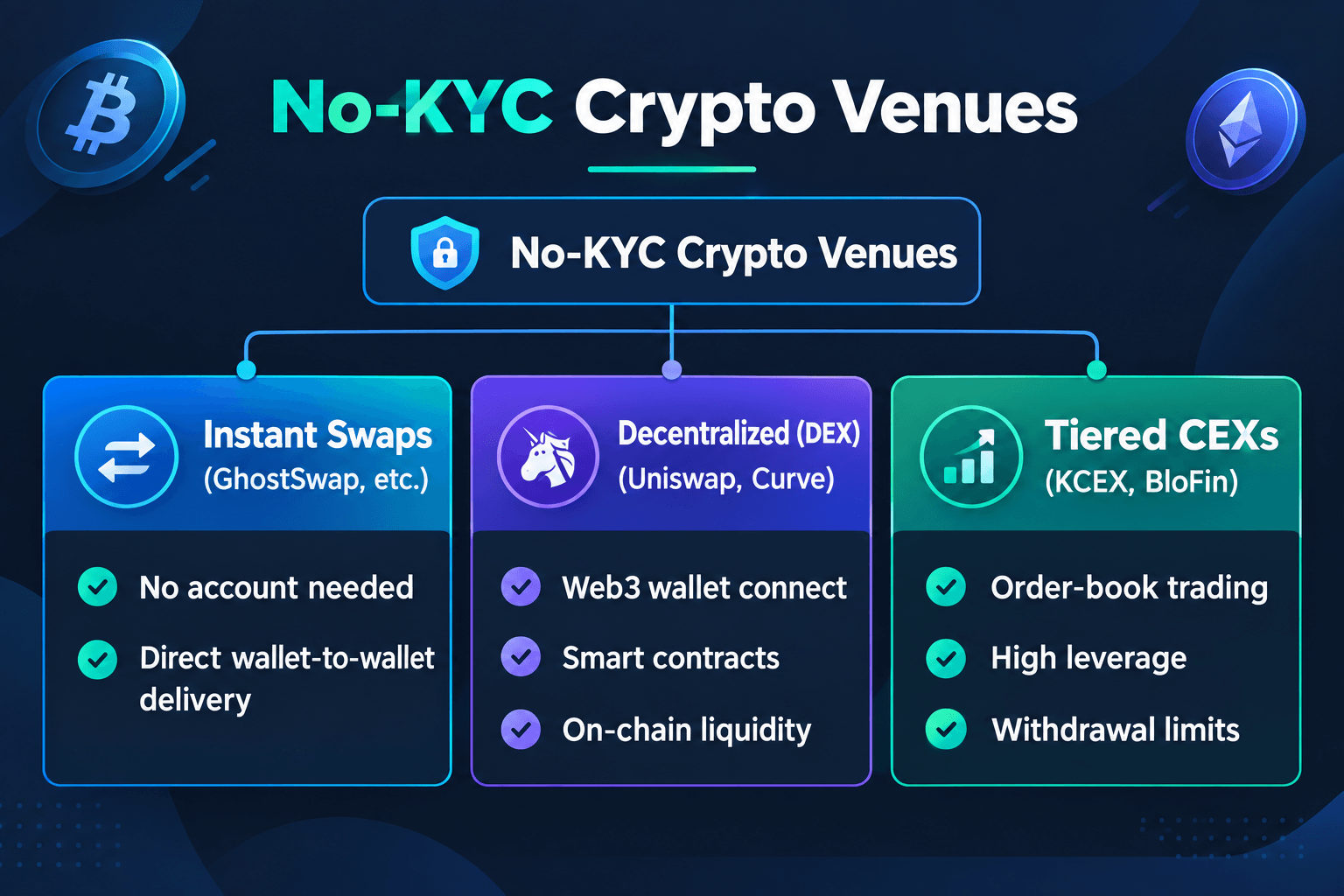
- Instant Swap Platforms: These platforms aggregate liquidity across the web. You send Coin A from your wallet to a designated address, and the service routes the swap, delivering Coin B back to your wallet.
- Decentralized Exchanges (DEXs): Smart contract protocols operating entirely on-chain. There is no central server, company, or human manager controlling your deposit.
- Tiered Centralized Exchanges (CEXs): Traditional order-book exchanges that allow crypto-only trading without ID. However, they do enforce daily withdrawal limits (e.g., 1–5 BTC per 24 hours) and reserve the right to flag suspicious accounts.
Risks and Limitations of No-Verification Trading

To maintain trust and realistic expectations, you must account for the drawbacks of trading on a no-KYC crypto exchange:
- Risk of Account Freezes on Centralized Venues: If you use a non-KYC CEX, remember that the platform holds custodial control over your funds. Their automated risk engines can trigger an algorithmic fraud flag, temporarily freezing your account until you submit ID verification.
- Slippage & Rates on Instant Swaps: Instant non-custodial routers build their fees into the execution exchange rate. During volatile market swings, slippage can end up higher than traditional CEX limit order execution.
- Limited Fiat On-Ramps: You cannot easily wire USD or EUR from a traditional bank account directly into an anonymous crypto exchange. Fiat on-ramps almost universally enforce strict KYC due to legal banking compliance.
- Irreversible Smart Contract Errors: If you make a mistake on a DEX (e.g., sending tokens via the wrong network chain or setting high slippage), there is no customer support team to reverse the transaction.
How to Trade Safely Without Identity Verification
If you choose to use a best no verification crypto exchange 2026 platform, follow these rules to safeguard your assets:
- Use a VPN (Virtual Private Network): Many centralized platforms use IP geofencing. A privacy-focused VPN protects your location data and keeps your connection secure.
- Rely on Self-Custodial Wallets: Never store large sums of capital on a centralized non-KYC exchange. Transfer your funds immediately to a self-custodial hardware wallet (like Trezor or Ledger).
- Start with Small Test Amounts: When testing an instant swap router or DEX for the first time, route a small transaction first to confirm speed and address accuracy before processing larger trades.
- Audit Web Address Domains Carefully: Phishing is the #1 threat in non-KYC trading. Double-check URLs and bookmark legitimate exchange portals directly.
How to Get Started: Executing Your First No-KYC Swap
Here is how simple it is to execute an instant cross-chain swap using a non-custodial platform:
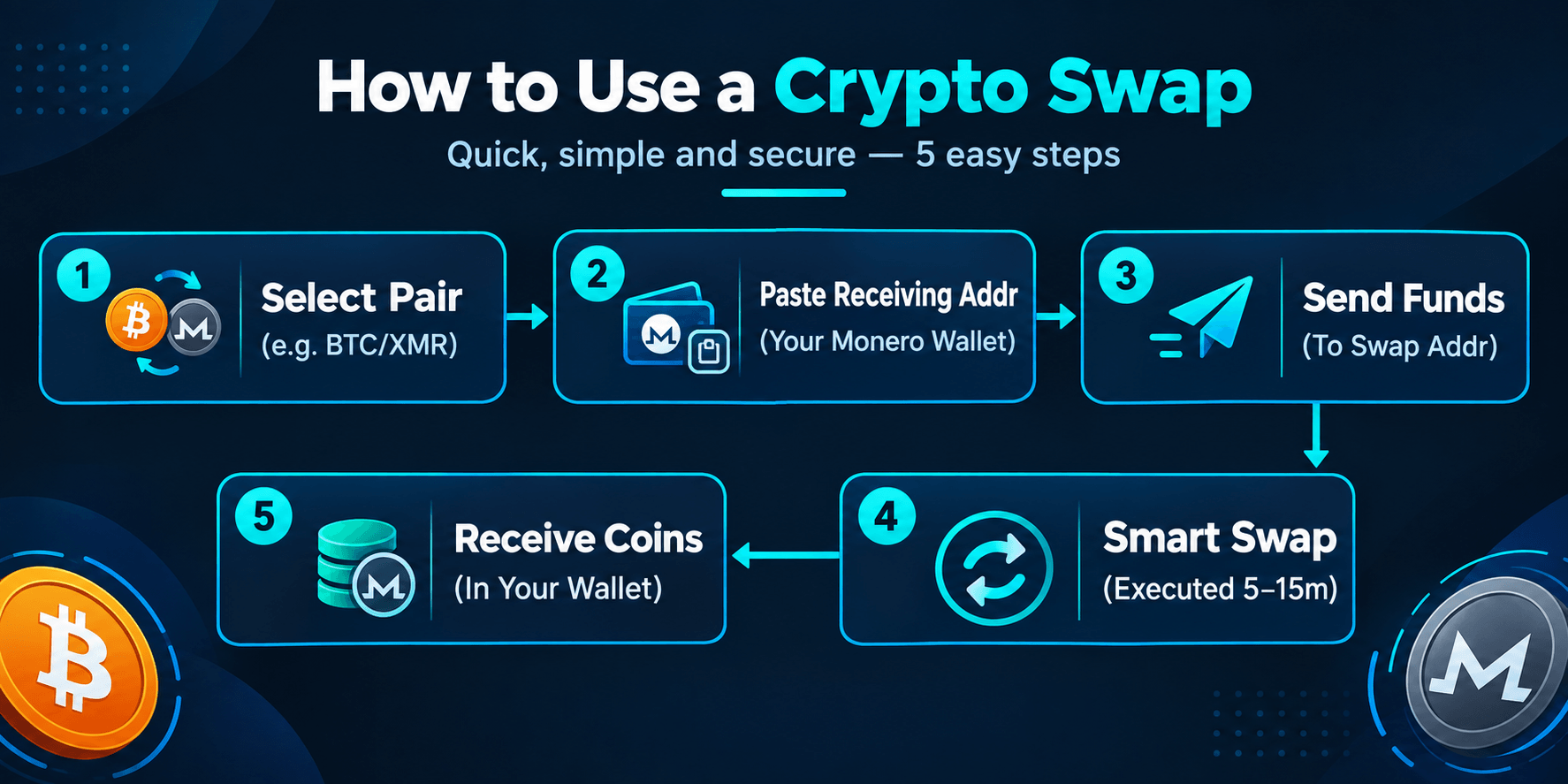
- Get a Self-Custodial Wallet: Install a trusted non-custodial wallet (e.g., Best Wallet, MetaMask, or Cake Wallet for Monero).
- Select Your Trading Pair: Visit an instant swap platform like GhostSwap, and select the token you want to send (e.g., Bitcoin) and the token you wish to receive (e.g., Monero or Solana).
- Input Destination Address: Paste your destination wallet address into the receiving field.
- Deposit the Crypto: Send the exact amount of crypto to the temporary deposit address provided on your screen.
- Receive Your Tokens: The automated routing system verifies your deposit on-chain and delivers your new tokens directly to your self-custodial wallet—with zero identity checks required.
Frequently Asked Questions (FAQs)

Is it legal to use a no-KYC crypto exchange?
In most international jurisdictions, using a non-KYC exchange is legal for individual privacy protection. However, tax laws still apply to crypto capital gains regardless of whether the exchange collected your personal details. Always consult local financial regulations.
What is the best no-KYC crypto exchange for mobile devices?
Best Wallet is widely regarded as one of the best mobile options, featuring a built-in DEX router, presale access, and multi-chain wallet management without requiring identity uploads.
Can I buy crypto with a credit card without KYC?
Generally, no. Fiat payment gateways (processing Visa, Mastercard, or bank wires) are legally obligated to enforce KYC compliance under anti-money laundering (AML) laws. No-KYC trading works best for crypto-to-crypto swaps.
What happens if a centralized non-KYC exchange asks for my ID?
If an automated risk system flags your account on a centralized platform (e.g., due to suspicious login locations or high withdrawal volumes), you may be required to complete identity verification to unlock your funds. To avoid this risk entirely, stick to non-custodial instant swap routers or DEXs.
Final Thoughts: Protecting Your Privacy
Finding the best non-KYC crypto exchange comes down to balancing convenience, speed, and overall security.
If you want complete peace of mind, pair a reliable non-custodial mobile wallet like Best Wallet with instant swap tools like GhostSwap or decentralized protocols like Uniswap. This keeps you in control of your private keys and protects your personal financial data from third-party exposure.